Ethereum Fees Jump 36% as RWA and Stablecoin Settlement Demand Rises
TokenPost.ai
Ethereum (ETH) network fees jumped roughly 36% over a single day as a burst of real-world asset (RWA) settlement activity and stablecoin flows concentrated into narrow time windows, tightening available blockspace and driving a sharp uplift in revenue. The move is notable not because of a simple price-linked spike in usage, but because it signals a shift toward 'high-value' payment and settlement demand—activity that tends to be stickier than speculative trading.
Market data showed ETH down about 2.69% on a snapshot basis during the same period, underscoring that the fee surge was not merely a function of token price momentum. Instead, the fee dynamics reflected intraday congestion as larger, institution-oriented transactions hit Ethereum mainnet and its Layer 2 (L2) networks simultaneously.
A key catalyst highlighted by market watchers is the expanding role of Circle ($CRCL) in onchain settlement—particularly its Arc L1 initiative and the broader scaling of USDC-based RWA payments. Arc is being framed less as a standalone chain and more as a payments and settlement rail designed to pull institutional capital onchain. As tokenized instruments such as U.S. Treasuries, T-bills, and commodities are increasingly settled using USD Coin (USDC) on Ethereum L2s, large batch transactions can cluster around specific cutoffs, amplifying temporary congestion and fee generation.
In that context, Ethereum’s fee revenue begins to resemble 'real yield' rather than simple transactional friction. The demand driver is not meme-coin speculation or retail bursts, but recurring clearing and settlement needs tied to institutional workflows. For Ethereum, this reinforces the thesis that the network continues to operate as a 'high-value network' where blockspace is priced by the economic value of the activity it supports.
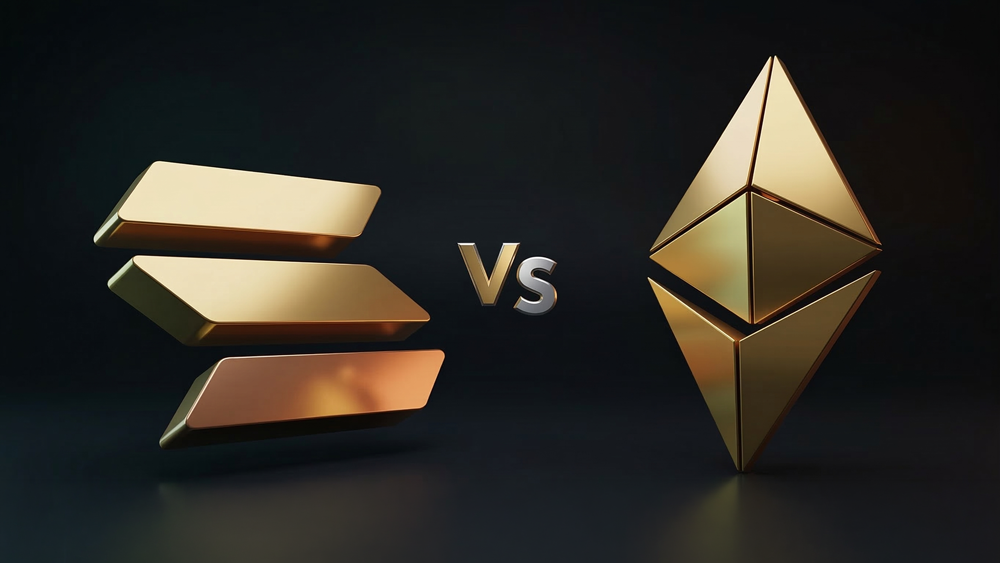
Solana (SOL), by contrast, posted only a modest 0.18% increase over the same window, with analysts pointing to 'stagnant throughput monetization' as a limiting factor. While Solana’s architecture is optimized for high-speed, low-cost execution and can process large volumes of transactions, critics argue the network’s revenue capture is structurally weaker—fees are comparatively thin and value accrual is more concentrated around validators rather than consistently flowing to long-term token holders.
That imbalance has been visible in Solana’s historical fee profile. During prior meme-coin cycles, annualized fees reportedly reached as high as $2.8 billion, only to fall sharply afterward—by as much as 79%—illustrating how quickly fee revenue can evaporate when traffic is primarily speculative and cyclical.
On a 30-day basis, the revenue gap also appears pronounced. Estimates cited by market participants put total fees at about $320.35 million for Ethereum versus $186.13 million for Solana—roughly a 72% advantage for Ethereum. Average daily fees were estimated near $10.7 million for Ethereum compared with about $6.2 million for Solana. Beyond raw totals, the networks’ value capture differs by design: Ethereum pairs fee burning with staking economics, while Solana’s distribution is more validator-centric, shaping how economic value accumulates across each ecosystem.
The divergence looks less like a one-off spike and more like an emerging structural trend. Over a 7-day cumulative window, figures referenced by analysts showed Ethereum at roughly $58.11 million in fees versus Solana at $34.78 million—maintaining a similar gap of about 67% even after smoothing out daily volatility.
One of the more counterintuitive dynamics supporting Ethereum’s revenue resilience is what some observers call the 'L2 scaling paradox'. Even as average fees per transaction have fallen toward the $0.01 range, total revenue has increased. The logic is economic: lower per-transaction costs can attract more institutional-grade settlement flows, expanding total payment volume and allowing the network to earn more in aggregate through 'scale effects'. In this framing, L2s such as Base and Arbitrum are not simply diluting fee capture; they are broadening the market, while still generating indirect value for Ethereum’s core settlement layer.
Solana’s challenge, analysts argue, is the mirror image. Transaction counts may remain high, but the unit economics are so compressed that network-wide revenue does not scale proportionally. The chain sustains a 'high-volume' model, yet its 'revenue density' per unit of activity remains comparatively low.
Overall, the episode adds weight to a market narrative that the competition among smart-contract platforms is shifting away from headline TPS metrics and toward which network can consistently process more economically meaningful transactions. Ethereum’s rising share of RWA and stablecoin settlement flows is increasingly viewed as a durable fee driver, while Solana is still broadly associated with traffic-led cycles. If these patterns persist, analysts say the long-run valuation gap between ecosystems may increasingly track differences in fee structure and revenue durability—because revenue remains one of the most direct indicators of sustainable network demand.
Article Summary by TokenPost.ai